After the Clocks Go Back: A Twenty-Minute Guide to the Winter Sky
On the first school evening after the clocks go back, many Bolitho families will notice that the kitchen lights are on before tea and the garden is already black. That early darkness can feel like a loss. It is also an opportunity. Between now and February, the UK sky offers some of the year's most recognisable stars at a civilised hour, and a family needs no telescope, no specialist knowledge and no late night to enjoy them. Twenty minutes outside after dinner is enough to turn a seasonal change into a practical lesson in Earth and space.
Why winter suits young observers
KS2 pupils learn that day and night arise from Earth's rotation; KS3 pupils meet seasons, Moon phases and the Solar System. A winter evening makes those ideas tangible in a way that a diagram cannot. The sky is dark before bedtime, the air is often clear after a cold front, and the brightest constellations are high enough to see without waiting until midnight. Unlike a summer stargazing session, which can collide with the school-night routine, a winter session can begin at six and end before seven. The main requirements are warm clothing, a little patience and an adult who is willing to stand outside in the cold for a short while.
What to look for in November and December 2026
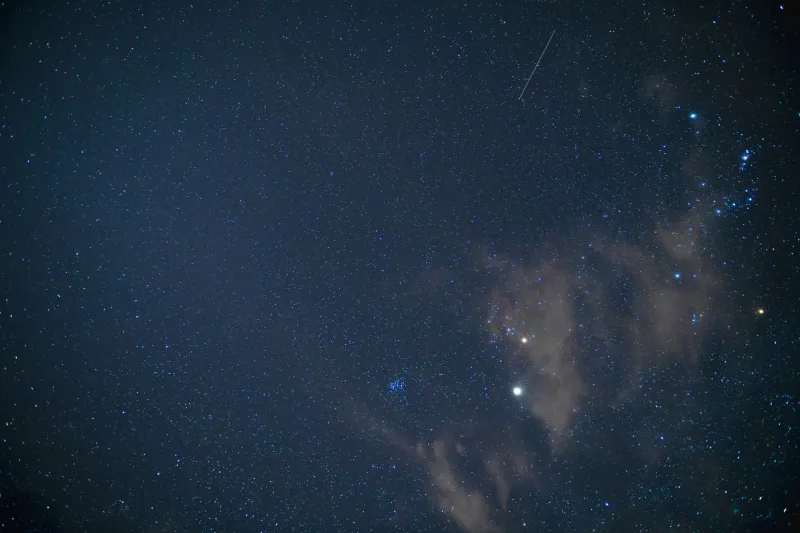
Start with the brightest and most familiar targets. The Moon is the easiest object for a first session; its phase changes from night to night, and even a simple sketch reveals that the terminator, the line between light and dark, moves across the surface. Towards the east, the constellation Orion becomes easier to find as the evening goes on; by December it is well placed before many children's bedtime. Look for the three stars of Orion's Belt in a short, straight line, then compare the reddish hue of Betelgeuse with the blue-white light of Rigel. Above and to the left of Orion lies Taurus, where the Pleiades cluster appears as a small, fuzzy group of stars to the naked eye and as a sparkling gathering through binoculars.
Around the middle of November, the Leonid meteor shower reaches its usual peak. The Leonids are produced by debris from comet Tempel-Tuttle and are not usually a dramatic storm, but they can produce bright, fast meteors. No equipment is needed: face away from street lights, look up at a wide area of sky and allow at least twenty minutes for your eyes to adjust. The International Space Station is another engaging target. It appears as a steady, bright point moving across the sky, usually within a couple of hours after sunset or before sunrise. Passes change from day to day, so use a reputable tracker such as NASA's Spot the Station service or a UK astronomy app. An aircraft will usually have flashing lights; the ISS generally does not.
Cutting light pollution at the garden level
Dark adaptation is the most important piece of equipment a family can own. It takes about fifteen to twenty minutes for the eye to adjust to low light, and a single white torch or phone screen can reset that process. Use a red torch, or cover a white torch with red cellophane, and keep it pointed at the ground. Switch off unnecessary outdoor lights, and if a security light is needed, set it to a motion sensor and aim it downwards. Indoors, close curtains in rooms that face the observing area and ask family members to avoid switching on garden floodlights while others are outside. These small changes reduce glare, improve what everyone can see and make the garden feel more like an observatory than a car park.
Three projects for a family science notebook
A Moon diary is the simplest place to begin. Observe the Moon at the same time each night for a week, sketch its shape and note the date, time and weather. Pupils can then explain why the visible shape changes and link the pattern to the Moon's orbit around Earth. A star-colour survey is equally accessible. Compare Betelgeuse, Rigel and the stars of Orion's Belt, rank them from reddest to bluest, and discuss how colour relates to temperature. For a technology link, try an ISS timing project: predict a pass, record the time it first appears, estimate how long it remains visible and compare the result with the tracker. Each project can be written up in a few lines with a sketch, a measurement and one sentence beginning 'I noticed that...'. That is genuine scientific recording, not a worksheet.
A twenty-minute routine
Check the forecast, dress in layers, step outside and leave the white lights off. Choose one target rather than trying to see everything. After ten minutes, look up and let the eye adapt. After twenty minutes, come inside, write one sentence and warm up with a hot drink. If cloud interferes, record the cloud cover; a cancelled observation is still a useful data point. Parents do not need to know the constellations in advance. Learning alongside a child is part of the exercise, and the Bolitho science hub would be glad to receive short family accounts or photographs for our community pages.
Winter darkness is not an obstacle to science at home. It is the condition that makes the sky visible. Twenty minutes, a warm coat and a shared notebook are enough to begin.