Bench, Tester, Repeat: The Pupil Workshop Giving Broken Gadgets a Second Life
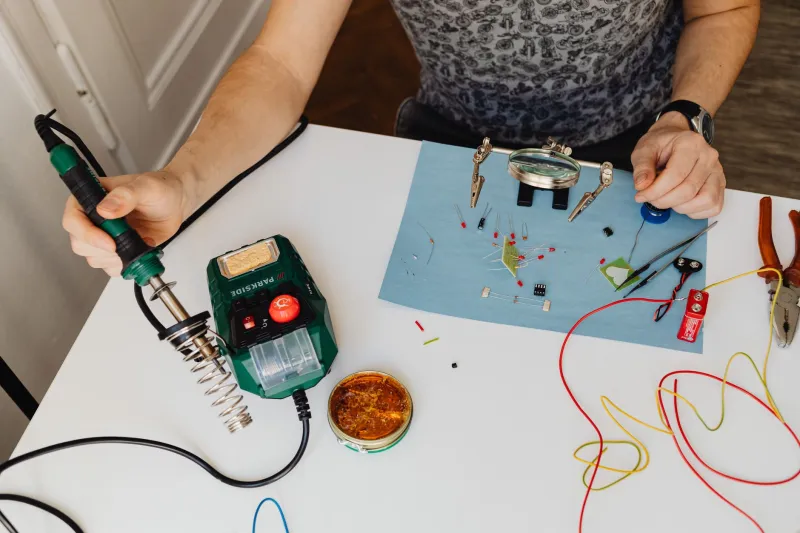
On Thursday afternoons, a corner of the design and technology room at Bolitho becomes a workshop of a different kind. Trays of discarded torches, tangles of headphones and small battery-powered appliances are laid out with testers, screwdrivers and labelled pots of screws. The pupils who gather there are not simply salvaging objects; they are learning to treat a fault as a question that can be investigated.
Why a flickering torch matters
A torch that flickers is rarely a dramatic failure. More often, the cause is a loose contact, a corroded spring, a tired battery or a switch that no longer makes a reliable connection. These are modest faults, but they make the principles of a circuit visible. Pupils learn to trace a path from cell to switch to lamp and back again, and to distinguish between a component that has failed and a connection that has simply become unreliable.
The club's approach is deliberately methodical. Pupils begin with a visual inspection, then test the battery, examine the contacts and, where appropriate, use a multimeter under staff supervision. They record what they observe before attempting a repair. That record matters: it turns a successful fix into evidence that can be explained to someone else, and it turns an unsuccessful attempt into a useful account of what was ruled out.
A standout repair
One recent achievement illustrates the club's purpose well. A Year 9 pupil was given a donated head torch that worked only when the cable was held at a particular angle. Rather than assuming the torch was beyond repair, she tested the battery, inspected the switch and traced the intermittent fault to a fractured solder joint near the strain relief. With staff supervision, she cleaned the joint, made good the connection and reassembled the torch. It has since returned to service in the club's own testing kit.
What made the repair notable was not only the fix. The pupil also produced a short fault-finding record: a simple flow chart showing the order in which she had checked battery, contacts, switch and cable. That chart is now used by newer club members when they encounter a torch that will not light. The achievement was recognised in a whole-school assembly, where the emphasis was placed on careful reasoning and persistence rather than on a lucky repair.
Beyond circuits
The repair club supports the school's wider commitment to pupil research. Members are encouraged to ask precise questions: What exactly happens when the switch is pressed? Does the fault change when the torch is warm or cold? Does the problem follow the battery or the device? These questions are small, but they build the habits of inquiry that serve pupils well across science.
The club also has a practical environmental dimension. Small electrical items are easily discarded when a simple fault is assumed to be terminal. By learning to test before replacing, pupils see that repair is often a realistic option and that responsible disposal is the last step, not the first. The workshop does not attempt to repair mains-powered equipment. Pupils work only on low-voltage, battery-powered items, and staff assess every donation before it reaches a bench.
Test before you replace: a family checklist
Families can use a similar approach at home, provided they keep safety first. The following checklist is suitable for low-voltage battery-powered items only. Mains-powered appliances should never be opened by pupils or families; they should be checked by a competent adult or recycled appropriately.
- Switch off and remove the batteries before inspecting the item.
- Look for obvious damage: a split cable, a swollen battery, corroded contacts or a cracked casing.
- Check the battery contacts for corrosion or looseness, and clean only in line with the manufacturer's guidance.
- Try a set of batteries known to be working.
- Test the switch and connections only if an adult is supervising and the item is low-voltage.
- Write down the symptoms: does the fault happen all the time, intermittently, or only when the cable is moved?
- Decide whether repair is sensible, or whether the item should be recycled through a suitable small electricals scheme.
An invitation to families
The repair club welcomes donations of safe broken items for future sessions. Suitable items include battery-powered torches, head torches, small headphones, low-voltage toys and similar small appliances. Please do not send mains-powered equipment, swollen or leaking batteries, damaged battery packs, or items that have overheated or burned. All donations will be assessed by staff before use.
Items can be left at school reception in the labelled repair club box, or passed to a form tutor with a short note explaining what the item is and what fault has been noticed. Families who are unsure whether an item is suitable are welcome to ask before donating.
A culture of careful curiosity
The repair club is not a competition to see who can fix the most objects. It is a setting in which pupils learn to slow down, test a hypothesis and explain their reasoning. A flickering torch is a small thing, but the habit of asking why it flickers, and of following that question through to a careful conclusion, is not small at all.