Beyond the Glare: A Bolitho Family Star-Count for Winter Evenings
As the clocks have gone back and the afternoons shorten, the sky above Bolitho becomes an easier place to study. The school grounds, the walk home and the view from a bedroom window all offer a patch of night sky, and all of them are affected by the light we cast upwards. This winter, Bolitho School Science Hub is inviting families to take part in a straightforward survey: a star-count that turns a few minutes of evening observation into evidence about local light pollution.
Why count stars at all?
Light pollution is often described in broad terms, but it can be measured by eye. The fewer stars a person can see in a fixed area of sky, the greater the effect of nearby lighting and general sky glow. Counting stars in the same patch, at roughly the same time and under similar conditions, produces a simple index. It is not a precise instrument, but it is a fair one, and it gives pupils something concrete to compare.
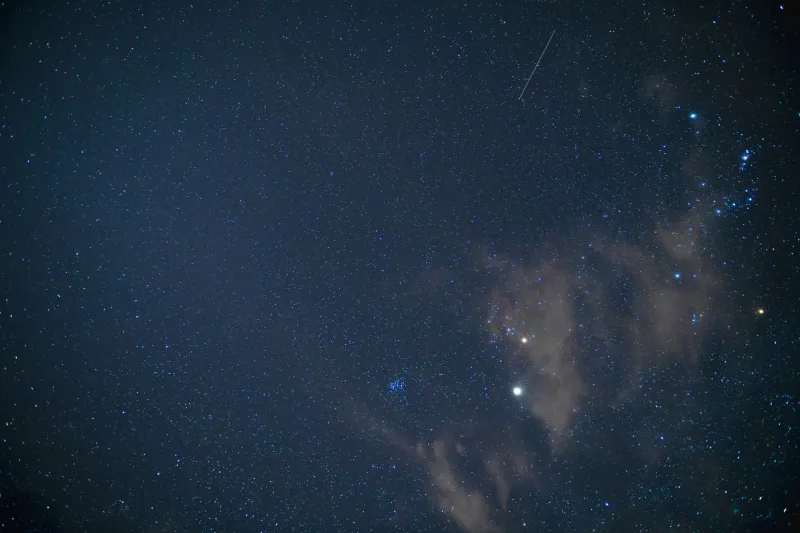
The survey is designed for winter 2026 because the evening sky is generous. Orion is well placed for much of the period, and the Plough remains familiar to many families. Both offer recognisable shapes that make a standard counting patch easy to describe. Pupils do not need a telescope; a clear view and a little patience are sufficient.
A fair test in the dark
The value of the survey depends on repetition. Families are asked to choose one patch of sky and keep to it. For most households, the four outer stars of Orion form a convenient rectangle. Pupils should count only the stars they can see inside that rectangle, without moving their position or using binoculars. The same method should be used at school and at home where possible.
Conditions should be recorded alongside the count. Cloud cover, the presence of the Moon and the time of observation all affect what is visible. A count taken through thin cloud is not comparable with one taken under a clear sky, and a bright Moon will reduce the number of faint stars seen. Recording these details is not a complication; it is the basis of a sensible comparison.
The tally sheet
A printable tally sheet will be available from the science office and on the school website. The sheet is deliberately short, so that the observation remains a family activity rather than a chore. A suitable record includes:
| Field | What to record |
|---|---|
| Date and time | Use the same evening window where possible, for example between 7pm and 8pm |
| Location | School field, playground edge, home window or garden |
| Cloud cover | Clear, partly cloudy or cloudy |
| Moon | Visible or not visible |
| Stars counted | Number seen inside the chosen patch |
| Nearest streetlight | LED, older sodium, unknown or none |
| Notes | Anything unusual, such as a security light or a lamp that appears shielded |
Pupils should also note whether the nearest lamp directs light downwards or spills sideways into gardens and windows. This is an observation, not a complaint. The aim is to build a picture of the lighting around the school, not to assign blame to any household or authority.
From tally to map
Completed sheets can be returned to the science office, where the results will be transferred to a shared map of the school grounds and the surrounding streets. A paper copy will be displayed in the science corridor, and a digital version will allow families to compare their own counts with others nearby. The map will show counts rather than names, and no personal details will be published.
Teachers will use the map in lessons to discuss variation. Two pupils living on the same street may record different counts if one looks towards a bright lamp and the other looks away from it. That difference is itself a useful finding. It shows that light pollution is not uniform, and that small changes in position or shielding can alter what is seen.
What darker skies mean
The survey does not assume that darker is always better in every respect. Street lighting serves safety and security purposes, and the school is not suggesting that lamps should be switched off without careful thought. Instead, pupils will consider three areas where light at night has recognised effects.
For wildlife, artificial light can disturb nocturnal insects, bats and birds. For energy use, light that escapes upwards or sideways is doing no useful work. For sleep, exposure to bright light in the evening can affect the body's internal clock, although the evidence is complex and depends on many factors. These points will be presented as questions for discussion rather than as simple certainties.
Safety after dark
Evening observations must be supervised by an adult. Pupils should wear something reflective, carry a torch with a red filter where possible, and stay on pavements and marked paths. Observations should be made from a safe place, away from roads and driveways. No pupil should look directly at a streetlight or climb to obtain a better view. Families should tell someone at home where they are going and when they expect to return.
Taking the findings to the school council
In January 2027, pupils will present the survey results to the school council. The presentation should be brief and evidence-led: the method, the map, and no more than three questions. Possible questions include whether the school could trial a lower-intensity setting on one non-safety-critical external light, whether the map should remain on display, and whether families should repeat the count in the spring to compare seasons.
The council will decide what, if anything, to recommend. The purpose of the exercise is to show that scientific evidence can inform a conversation, not to predetermine its outcome.
How to take part
The observation window runs from 23 November to 6 December 2026. Completed tally sheets should be returned by 11 December 2026. Families who miss the window may still submit a single count before the end of term, but the main comparison will use the two-week period.
A star-count is a modest activity. It requires no equipment beyond a tally sheet, a pencil and a warm coat. Yet it produces something that a classroom discussion alone cannot: a set of local observations, made by many people, that can be compared and questioned. For pupils at Bolitho, that is a useful introduction to how scientific evidence is gathered in the world beyond the laboratory.