Crusts and Rosettes: A Repeatable Lichen Survey for Bolitho's Boundary Walls
On a damp morning in the autumn term of 2026, a group of Bolitho pupils set out with clipboards, a 30 cm card frame and a hand lens. Their task was not to identify every lichen on the school site, but to answer a narrower and more useful question: can a carefully designed survey show a pattern in the lichens growing on different surfaces around the grounds?
Lichens are familiar but easily overlooked. They are not plants, and they are not single organisms. Each lichen is a partnership between a fungus and one or more photosynthetic partners, usually algae or cyanobacteria. That partnership is sensitive to changes in the air, particularly to sulphur dioxide and to nitrogen-containing pollutants. For that reason, lichens have a long history in the UK as informal indicators of air quality. They are not instruments, however, and a school survey must be honest about the difference between a suggestive pattern and a measurement.
Why walls are useful, but not simple, instruments
School grounds offer a practical advantage: the same observer can compare many surfaces within a short walk. A boundary wall beside a road, a sheltered courtyard wall and the bark of mature trees may all be sampled in a single session. If the lichens differ between these locations, the difference is worth investigating.
The difficulty is that lichens respond to more than pollution. Stone type, mortar chemistry, surface texture, age, shade, moisture and aspect all influence which species can establish. A sunlit wall of alkaline mortar is a different habitat from a shaded tree trunk with acidic bark. Pupils therefore had to record these conditions alongside the lichens themselves, rather than treating every surface as directly comparable.
A second complication is that different pollutants have different effects. Historic sulphur dioxide pollution, associated with coal burning, reduced many lichen species across industrial Britain. Since the Clean Air Acts and later reductions in emissions, some sensitive species have returned to areas where they had been lost. Nitrogen-containing pollutants, largely from vehicle exhausts and agriculture, create a different pattern: some nitrogen-tolerant species flourish, while others decline. A survey that records only 'lichen present' or 'lichen absent' will miss this distinction.
Designing a survey that can be repeated
The pupil group settled on three transects: the boundary wall facing the road, an internal courtyard wall, and a line of tree trunks in the shelter belt. Within each transect they placed ten 30 cm by 30 cm quadrats at a fixed height of between 1.2 and 1.5 metres. Where possible, the same aspect was used at each quadrat, and the frame was positioned with its top edge horizontal.
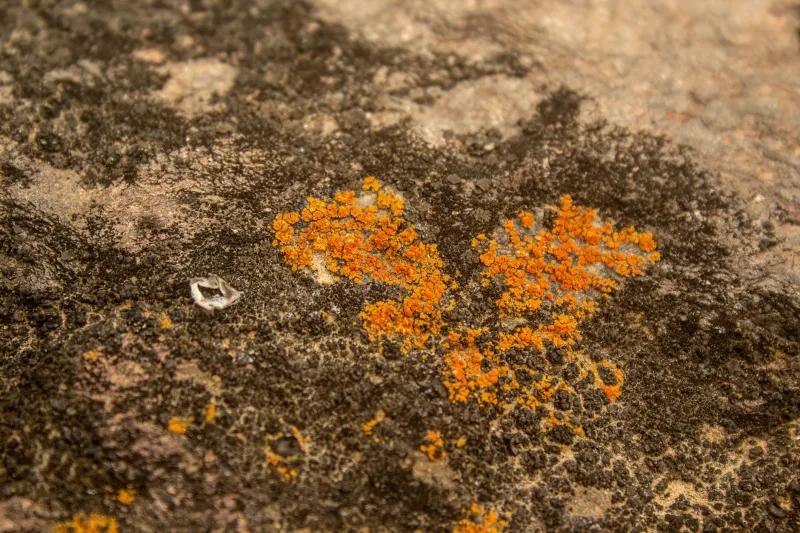
Inside each quadrat, pupils recorded the growth form of the lichens present. Crustose lichens form a thin crust tightly attached to the surface. Foliose lichens have leaf-like lobes. Fruticose lichens are shrubby or strap-like. Where pupils were confident, they also recorded a genus, such as Xanthoria or Parmelia, but the main record used growth form and an abundance score from 0 to 3. This kept the method within the group's identification skills while still producing data that could be compared.
Each quadrat was photographed, and the date, weather, substrate, shade and dampness were noted. Two pupils checked each record before it was entered. That may sound laborious, but it is the difference between a pleasant nature walk and a dataset that another class could repeat in the same way.
What the evidence can and cannot support
A survey of this kind can support comparisons within the school grounds. It can show whether a particular wall carries more crustose cover than a particular group of trees. If the method is repeated without change, it can show whether the pattern is stable over time. It can also generate hypotheses for further work, such as whether road-facing surfaces differ consistently from sheltered ones.
It cannot establish that a specific pollutant is present at a specific concentration. It cannot show that one location is 'safe' or 'unsafe', and it cannot substitute for monitoring by the local authority. The presence of a nitrogen-tolerant lichen on a roadside wall is consistent with traffic-related pollution, but it is also consistent with the wall's mortar, its age and its exposure to sunlight. Good science teaching requires pupils to say this plainly rather than to overstate the result.
A further limitation is observer error. Lichen identification is difficult, and two pupils may disagree about whether a patch is one species or two. Recording growth form and using a simple abundance scale reduces this problem, but it does not eliminate it. The group's solution was to keep voucher photographs and to ask a more experienced observer to review a sample of the quadrats.
A family version for your own street
Families can adapt the method without special equipment. Choose ten trees of the same species, or ten similar stone surfaces, and mark a sampling height of about 1.3 metres. Use a 20 cm by 20 cm frame cut from card, and record the growth forms visible inside it. A simple score of 0 for none, 1 for sparse, 2 for moderate and 3 for abundant is sufficient. Photograph each frame and repeat the survey once a month, ideally on a dry day.
A few practical rules matter. Seek permission before sampling on private land, keep away from busy road edges, and wash hands afterwards. Do not scrape or remove lichens. The aim is to observe, not to collect. Families who want to go further can compare their street with a park or a churchyard, where older stone and mature trees may offer a different picture.
What happens next at Bolitho
The pupil group intends to repeat the survey in the spring term, using the same transects and the same frame size. They will also compare their photographs with published guidance from the British Lichen Society and with local air-quality information. The immediate lesson is not that the school's walls have delivered a verdict on air quality. It is that a modest, repeatable method can turn a familiar surface into a source of evidence, provided the claims are kept in proportion to the method.