The Playground Sundial: Reading November's Low Sun at Bolitho
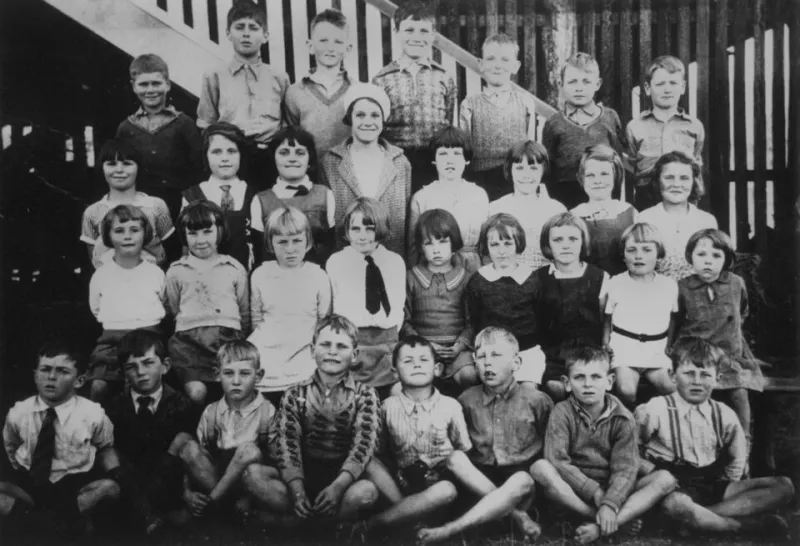
Photo: Unknown, Public domain, via Wikimedia Commons
On a bright November day, a playground can become a simple solar observatory. That is the thinking behind Bolitho's long shadow survey, in which pupils return to the same fixed point at intervals and record how the shadow cast by a vertical object changes in length and direction. The activity looks modest: a cane, a tape measure, a compass and a record sheet. Its purpose is larger. It gives pupils direct evidence of the Sun's apparent movement across the sky, the shortness of winter daylight and the effect of Earth's tilt.
A modest question, carefully framed
The investigation begins with a question that is narrow enough to answer well: how does the length and direction of a fixed object's shadow change at selected times across a November school day? The wording matters. Pupils are not simply asked whether shadows are 'long' or 'short'; they are asked to compare measurements taken from the same object, on the same ground, using the same method.
This makes the survey a fair test. The factor deliberately changed is time. The factors kept the same include the object casting the shadow, the surface on which the shadow falls, the measuring equipment and the point from which each measurement is taken. Pupils also note cloud cover, because a passing cloud can soften an edge and make the shadow tip harder to judge. Recording such conditions is not a distraction from the science; it is part of honest evidence.
Why November is an honest month for shadow work
In west Cornwall, November offers a useful combination of low Sun and short daylight. The clocks have gone back to Greenwich Mean Time, and the Sun's arc across the sky is compressed compared with summer. At solar noon, the Sun's altitude is modest, so even a short object casts a comparatively long shadow. Early and late in the school day, the shadow is longer still.
There is an important distinction between clock noon and solar noon. Solar noon is the moment when the Sun is at its highest, due south in the UK. It does not always coincide with 12 o'clock on a clock, because of longitude and the equation of time. In west Cornwall, solar noon falls somewhat later than at Greenwich. Pupils do not need to calculate this correction to run the survey, but they should record the actual clock time of each measurement and avoid assuming that 12.00 is automatically the turning point.
Measuring length and direction reliably
A reliable survey starts with a stable object. A metre cane held vertically in a bucket of sand works well, provided it cannot shift during the day. A fixed post or a purpose-built marker can also be used, but the base of the object must be marked clearly so that every measurement starts from the same point.
Pupils then follow a short protocol:
- Mark the base of the object with chalk or tape.
- Measure from the base to the tip of the shadow along the ground, keeping the tape taut and level.
- Record the length in centimetres or metres, to the nearest centimetre.
- Use a compass to record the direction from the base towards the shadow tip, using a compass bearing or a clear eight-point description such as north-west.
- Note the time, cloud cover and any other condition that might affect the reading.
- Repeat the reading if the shadow edge is unclear, and record the average if appropriate.
Pupils should never look directly at the Sun. The shadow itself is the observation. Adults should also check for trip hazards and keep tape measures clear of busy routes.
From record sheet to display
The first display is usually a table: time, shadow length, shadow direction and conditions. From this, pupils can plot a line graph of shadow length against time. The graph should have time on the horizontal axis and length on the vertical axis, with a clear title and labelled units.
Direction is better shown as a diagram than as a line graph. A simple compass rose with arrows drawn from the base point at each recorded time makes the change visible. If different classes use objects of different heights, pupils can calculate a ratio by dividing shadow length by object height. This allows a short cane and a taller post to be compared more fairly, although the core survey should still keep one object fixed.
Reading the pattern
In a typical run, the data show two linked patterns. First, the shadow is shortest around solar noon and longer at the start and end of the school day. Second, the shadow direction turns through the day. In the morning, with the Sun in the south-east, the shadow points towards the north-west. Near solar noon, with the Sun due south, the shadow points towards north. In the afternoon, with the Sun in the south-west, the shadow points towards the north-east. The direction therefore turns clockwise from north-west through north to north-east.
The explanation lies in Earth's rotation and tilt. Earth spins on its axis once a day, making the Sun appear to move across the sky from east to west. Earth's axis is also tilted by about 23.5 degrees. In November, the northern hemisphere is tilted away from the Sun, so the Sun's midday altitude is lower than in summer. A lower Sun sends light at a shallower angle, and the same object therefore casts a longer shadow. The shortening days and the long shadows are two expressions of the same seasonal geometry.
Repeating the survey at home
Families can repeat the investigation without special equipment. Choose a fixed post in a garden or a safe outdoor space, or use a cane pressed firmly into soil. Mark the base, then measure the shadow at three or four set times on a sunny day, such as mid-morning, midday, mid-afternoon and late afternoon. Record the direction with a compass or a phone compass, taking care to use the same method each time.
A home survey does not need to match the school's times exactly. The value lies in the comparison: does the shadow shorten towards midday? Does it lengthen again later? Does its direction turn in the expected way? If a cloudy day interrupts the survey, pupils can note the gap and return on another clear day rather than filling in invented readings.
What the survey teaches
The playground sundial is a small piece of fieldwork, but it models several habits that matter in science. Pupils define a question, control variables, measure carefully, record uncertainty and display evidence clearly. They also learn that a familiar sight, such as a shadow crossing the tarmac, can become data when it is observed with purpose. For parents and local families, the appeal is equally practical: the investigation can be repeated at home, on a school run or in a local park, and it connects a simple outdoor observation to the wider rhythm of the seasons.