Strength, Shine and the Recycling Bin: A Pupil-Led Materials Inquiry
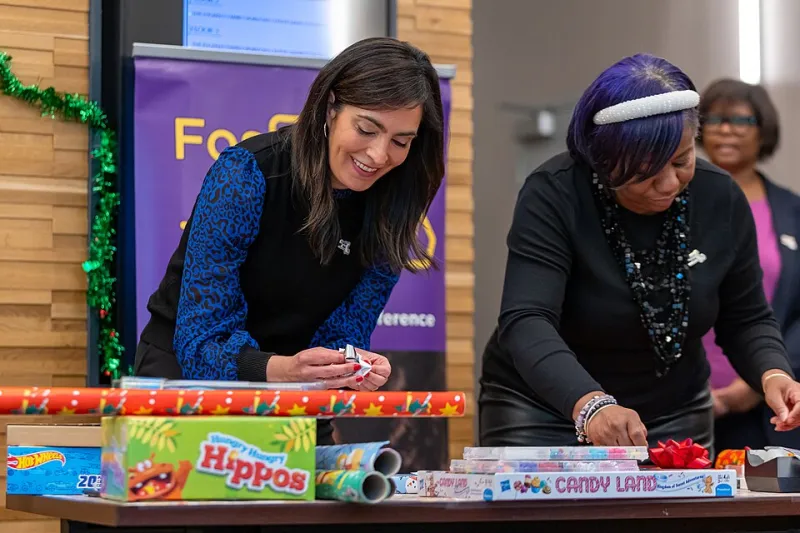
Photo: Joshua Qualls/Governor’s Press Office, Public domain, via Wikimedia Commons
As the autumn term moves towards its close in December 2026, a group of Bolitho pupils has been giving unusual attention to a familiar household material: wrapping paper. Rather than treating festive paper as decoration alone, the science club has begun a pupil-led inquiry into its physical properties and its journey from shop shelf to tree and, eventually, to the recycling bin. The work sits firmly within the school's commitment to practical science, but its starting point is deliberately ordinary. A roll of paper is cheap, abundant and visually appealing. It is also a surprisingly rich subject for a fair test.
A familiar material with unfamiliar questions
The project began with a simple classroom observation. Wrapping paper varies enormously. Some sheets are thin and matte; others are glossy, metallic or heavily printed. Some tear at the slightest tug, while others resist the first pull and then split unpredictably. Pupils noted that packaging often carries environmental claims, but those claims are not always easy to interpret. A label may say that paper is recyclable, yet the same sheet may include foil, glitter or a laminated layer that complicates household disposal.
Rather than accepting the label as the final word, pupils framed three practical questions. How much force is needed to start a tear? How well does a creased sheet recover when opened out? And what evidence can families reasonably use when deciding whether a paper is likely to be accepted for recycling? These questions shifted the project from a seasonal craft activity to a materials-science investigation with clear variables and measurable outcomes.
Designing a fair comparison
The first task was to make the comparison fair. Pupils recognised that tearing paper by hand would introduce too many differences between testers. Instead, they prepared strips of equal length and width, cut in the same direction relative to the roll, and used a simple weighted rig to apply force steadily. A small notch was made at one end of each strip to give the tear a consistent starting point. Pupils then added masses gradually and recorded the point at which the tear began to travel across the sheet.
This was not a perfect industrial test, and pupils were clear about that limitation. The rig was designed to produce comparable classroom evidence, not laboratory-grade tensile data. What mattered was consistency: the same strip dimensions, the same notch depth, the same method of adding mass and the same definition of when a tear had started. In discussion, pupils identified the variables they needed to control, including paper thickness, surface finish and the presence of metallic or plastic layers. They also agreed that each paper type should be tested more than once so that a single unusual sheet would not distort the class result.
Crease recovery required a different approach. Pupils folded each sample under a standard weight for a set time, then opened it and compared the angle of the crease after a fixed interval. Again, the method was modest but repeatable. The aim was not to rank papers by appearance, but to gather evidence about how a sheet behaves when folded around a present and then handled during transport.
When the label and the sheet disagree
The recyclability strand produced the most discussion. Pupils quickly discovered that a single word on a label can hide considerable complexity. Shiny paper may contain a metallic coating. Glitter can contaminate the recycling stream. Heavily laminated paper may behave more like a composite than like plain paper. Pupils also learned that local council rules vary, and that a classroom test cannot replace the guidance provided by a household's own waste collection service.
This was an important lesson in scientific caution. The pupils did not attempt to certify any paper as universally recyclable. Instead, they built a decision guide that separates what can be observed from what must be checked. Families are encouraged to look for paper that tears cleanly, avoids heavy metallic or plastic coatings, and can be scrunched rather than springing back like a plastic film. Even then, the guide advises checking the local authority's accepted materials list before placing paper in the recycling bin. The wording is deliberately careful: the project offers evidence-informed questions, not sweeping claims.
From classroom data to family guidance
The final output will be a short family guide, produced by pupils for the Bolitho community. It will include a simple comparison table, a brief explanation of the test methods and a set of questions to ask in the shop. Does the paper tear easily? Does it hold a crease? Is the shine a surface finish or a separate layer? Can the sheet be scrunched? Does the local council accept it? The guide will also remind families that reuse is often preferable to recycling, particularly for paper that has been used only once and remains in good condition.
Teachers involved in the project have emphasised that the investigation meets several aims at once. It gives pupils experience of planning, measuring and reviewing evidence. It requires them to handle conflicting claims with restraint. It also connects a familiar seasonal activity to broader questions about materials, waste and everyday sustainability. For parents, the guide offers a practical way to continue the conversation at home without turning it into a lecture.
What the project demonstrates
The wrapping paper inquiry is a reminder that good science does not require expensive equipment. It requires a clear question, a fair method and a willingness to report what actually happens. Pupils have learned that strength, shine and recyclability are not simple opposites. A paper that looks luxurious may perform poorly in a tear test; a plain sheet may prove more robust and easier to process. Those findings are useful precisely because they are modest and testable.
As the term draws to a close, the science club will complete its repeats, collate the class data and finalise the family guide. The results will not settle every question about festive packaging, and pupils are comfortable with that. The project's value lies in the habits it builds: careful observation, controlled comparison and honest reporting. In that sense, a pile of leftover wrapping paper has proved to be a genuinely useful teaching resource.